About SharingwithWriters Blog


Named to "Writer's Digest 101 Best Websites," this #SharingwithWriters blog is a way to connect with my readers and fellow writers, a way to give the teaching genes that populate my DNA free rein. Please join the conversation using the very tiny "comment" link. For those interested in editing and grammar, go to http://thefrugaleditor.blogspot.com.
Showing posts with label editing. Show all posts

Monday, June 22, 2026

Why Should You Edit Before Self-Publishing?


 Contributed by Karen Cioffi, Children's Writer and Self-Publisher

 Self-publishing is amazing. It has brought the world of publishing into the hands of everyone and anyone who wants to write a book. It has brought writing power and freedom to all.

But, with writing power and freedom comes responsibility. This is especially true when writing for children.

This means that while it’s true that self-publishing has opened a tremendous amount of doors and anyone can now write and publish a book, it doesn’t mean you can slap anything together and self-publish. You need to produce quality (edited) content for three reasons.

There are at least three reasons you should edit your manuscript before you self-publish:

Reason number one: You have an obligation to your reader.

You want to give the reader her money’s worth. Whether it’s fiction or nonfiction, you want to create a book that will engage the reader. You don’t want the reader to stumble over grammatical and content errors while reading.

One drawback to the ease of self-publishing is that those new to the arena don’t realize they should hone their craft before actually publishing a book. This means taking the time to learn about writing and self-editing, and realizing the importance of hiring a professional editor to edit the book before giving it to the world.

Reason number two: You have an obligation to other writers.

Part of the problem today is the ‘I want it now’ syndrome that self-publishing tends to foster. Authors don’t want to take the longer ‘proven’ road. But learning the ropes really does matter.

Once your book is ‘out there,’ it becomes another determining factor as to whether self-published books are of the same quality as traditionally published books. This is where your obligation to other writers comes into play. It’s not fair to diminish the value of self-published books.

Reason number three: Self-editing is a good book marketing move.

In book marketing 101, the first step is to create a quality product. In a webinar, pro marketers Daniel Hall and Jason Fladlien discussed the importance of ‘the offer’ (your product) compared to the sales copy. By far, a quality product is much more important.

If your intent is to publish only one book, then quality may not matter from a marketing perspective. The saying goes, ‘if you fool me once, shame on me.’ If this is the scenario, then you don’t have to worry about readers/purchasers buying more from you. But, you’ll need to be careful here, because word-of-mouth is lightning fast in the internet world. This could easily stop your one-time purchasers as well.

On the flip side, let’s assume you love writing and have decided to earn an income from it. Then, self-editing will play a huge part in your book marketing success. If you produce a substandard product (book), it will discourage a customer from buying your future books.

Remember, a great product will not only sell itself, but it will usually write its own copy. Editing before publishing helps create a quality product.

ABOUT THE AUTHOR


Karen Cioffi is an award-winning children’s author, writer, and self-publisher with clients worldwide. For more tips on writing for children or if you need help with your children’s story, please visit Karen Cioffi Writing for Children. While there, you can check out Karen’s books. 

And don’t forget to CONNECT. 

-----

A feature in the right column of this blog lets you subscribe to #SharingwithWriters so you don’t miss any of Karen’s posts on writing for children.   

-----


A feature in the right column of this blog lets you subscribe to #SharingwithWriters so you don’t miss any of Karen’s posts on writing for children.  

MORE ABOUT THE BLOGGER Carolyn Howard-Johnson is the multi award-winning author of fiction, creative nonfiction, and poetry. She is also a marketing consultant, editor, and author of the multi award-winning #HowToDoItFrugally Series (https://www.amazon.com/dp/B0BTXQL27T/ ) of books for writers including "The Frugal Book Promoter" (https://bit.ly/FrugalBookPromoIII), and "The Frugal Editor" both offered in their third editions by Modern History Press. Others in that series are "How to Get Great Book Reviews Frugally and Ethically," and two booklets, both in their second editions also from Modern History Press. The booklets, "Great Little Last Minute Editing Tips for Writers" (https://bit.ly/LastMinuteEditsII) and "Great First Impression Book Proposals" (https://bit.ly/BookProposalsII) are career boosters in mini doses and both make ideal thank you gifts for authors. The one on writing book proposals is also available as an Audio Book. "The Frugal Editor "(https://tinyurl.com/TheFrugalEditor), was recently released in its third edition. It is the winningest book in this series for writers. Carolyn also has three frugal books for retailers including one she encourages authors to read because it helps them understand what is needed to convince retailers to host their workshops, presentations, and signings. It is "A Retailer’s Guide to Frugal In-Store Promotions: How To Increase Profits and Spit in the Eyes of Economic Downturns with Thrifty Events and Sales Techniques" (https://bit.ly/RetailersGuide). In addition to this blog, Carolyn helps writers extend the exposure of their favorite reviews at https://TheNewBookReview.blogspot.com. She also blogs all things editing--grammar, formatting and more--at "The Frugal, Smart, and Tuned-In Editor" (https://TheFrugalEditor.blogspot.com). Learn more and follow it to get news on her new releases directly from Amazon at https://bit.ly/CarolynsAmznProfile.

Wednesday, January 17, 2024

Carolyn Shares a Memoir-ish Account of Her Love of Words


This is a blogpost replay. It originally appeared in a print magazine and then the Insecure Writers Group’s (ISWG) blog. I’m publishing in in my own blog today because I ran across it when I was searching for ideas among my own files for a new booklet for my HowToDoItFrugally Series of books for writers from #ModernHistoryPress. It should be in print in early 2024! This story shows a little about how a love for words (in this case “The Vocabulary Habit” led to lots of freelance work for me…and lots of new friends in the publishing industry. It brings back memories for me. I hope it leads to some memories for your own writing past—maybe a submission to this blog! We’ll make our own little #SharingwithWriters blog series. Maybe we’ll have a contest for what to call it.  Something like "SharingwithWriters Book of Memories." I bet you can come up with a better name! 


I was in love with writing—and even grammar—long before I was in love with words. I became smitten with words about the same time I fell in love with my husband about sixty-three years ago. When we opened the door to our new one-bedroom apartment ($75. a month, I kid you not!), we found a tattered book that once belonged to a previous tenant. It was one of the early paperbacks (pocketbooks) called something like “A Word a Day” and we committed exactly that—one word a day—to memory before we went to sleep each night. We did it together. That list was spot-on. It produced a list of words that appear on later SAT exams and a Graduate Record Exam (GRE) or two.


My vocabulary-intensity rating went up and down after that, mostly down. Jobs, children, and a business interfered. But lately it crescendoed along with my interest in poetry. And then one day (it was a cloudy, uneventful day during my self-imposed isolation during the Days of Covid) an email from WordGenius appeared in my email box. I may have signed up for it. If I did, I don’t remember, and I was a bit annoyed. Spam, I thought. But I played their little games and got hooked again. Then the emails kept getting more frequent. New and even more fun features. It was a little like the internet in general, designed for addiction.


I was especially intrigued with the words that were directly related to writing. They reminded me of a column I once wrote for a print magazine in the early 2000s for…was it Writer’s Magazine? I remembered what the column was called so I did a search in my computer for “Affecting Words” and there they were. Every single column. Soon I was adding words I collected from my new email games that I might someday use for more “Affecting Words” columns, words I didn’t know then, some words I had never heard!


That list is getting longer, and I started thinking about a kind of memoir based on the love of words—especially words associated with writing—and what Carolyn See, a now-deceased writing friend called The Writing Life in her memoir. 


And then it turned out that another auspicious email from Elizabeth Seckman, the editor of an IWSG newsletter I had subscribed to after I met a delightful young woman at a #writersconference in North Carolina. (That’s a good lesson on keeping in touch with people we meet in whatever industry our chosen profession happens to be in!). It wasn’t too long before I suggested a regular “The Vocabulary Habit” column to the powers that be at IWSG and authors and fans had new series from me showing up in their mailboxes.  That allowed me to continue to indulge in this newly revived addiction of mine. And I made a new friend with their newsletter’s editor, Elizabeth Seckman. I might have worn her out and now I’m working with another editor, Juneta Keyes!


If you are wondering if an author—a wordsmith by trade—could possibly need a word game other than The New York Times’ crossword puzzle you might already be addicted to, be sure to subscribe to ISWG’s newsletter and watch for the new booklet I’ll be doing for my series of books for writers. The booklet will be a little different; it will be limited to only writing-related words and if you don’t know some of them, you might someday wish you did. It’s all part of the writing business.

Here are some of “my” original Affecting Words” as a little test to see if you think you might run across some you need. As you can see, most are associated with writing or publishing in some way. Some may even nourish your crossword skills! In any case, why not give it a try! And send me words you’d like to see there at HoJoNews @ AOL dot com with “The Vocabulary Habit” in the subject line. 


Demiurgic

Palimpsest
Semantic Narrowing

Metonymy 

Asyndeton

Antiphon

Synecdoche (one of my favorites) 


Test yourself. Or join WordGenius.com and play with me. (No I don’t get paid for inviting you!) Of course, all my IWSG words won’t have appeared there and may not have appeared there in the past. 


Have I written the first page of that book I mentioned? Yes. But it’s slow going. Do you want to take bets on whether I do? I believe I will if I live long enough. But here’s the thing. In the meantime, I have lots of meat and potatoes for just such a book and I have renewed and fostered an old love. And all of you who visit and subscribe to ISWG will be helping me with my trek. What more could one ask from reviving an old habit (or is it a hobby?) than that? 


MORE ABOUT THE BLOGGER:


Carolyn Howard-Johnson brings her experience as a publicist, journalist, marketer, editor, and retailer to the advice she gives in her HowToDoItFrugally Series of books for writers and the many classes she taught for nearly a decade as instructor for UCLA Extension’s world-renown Writers’ Program. The books in her HowToDoItFrugally Series of books published by Modern History Press include the third editions of  both the multi award-winning The Frugal Book Promoter and The Frugal Editor which won awards from USA Book News, Readers’ Views Literary Award, the marketing award from Next Generation Indie Books and the coveted Irwin award in its earlier editions. Yes, she also loves #SharingwithWriters anywhere she can. Thank you, #IWSG, #WritersontheMove, #SPARREW and all the other bloggers who have not discouraged me from sharing my love of words.


PS: To be notified of the new book when it comes out, follow me on my Amazon Author Profile. Did you know Amazon offers such a thing free and when as you publish each new book Amazon notifies all those who have signed up to follow you. It’s a great way (and one of the only ways!) to even know who the multitude of readers who have searched for you or your books on Amazon are.  Did I say it’s FREE? Find mine at https://bit.ly/CarolynsAmznProfile.


Sunday, November 05, 2023

Carolyn Celebrates #2 Birthday of the 3rd Edition of Her The Frugal Editor


To My SharingwithWriters Blog Subscribers and Visitors:

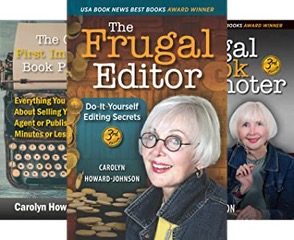
As this year of 2023 draws to a close, I am celebrating the first year anniversary of the release of the third edition of The Frugal Editor, the winningest book in my #HowToDoItFrugally Series of books for writers, and I don’t want to let the year pass without reaching out to even more readers of a book so plainly a huge helpmate for authors to matter where they are in their careers. My publisher says there is approximately 50% new material in this edition. It will have something new in it for anyone with a new book in the works.

My publisher (Modern History Press) also says, “We really overachieved on this book. There's nothing within a mile of it in terms of scope and depth.” One of the reasons for such praise is the inclusion of information on front matter that is as likely to assure a great first impression for a book as a great cover and one that books on editing or publishing rarely cover. So today’s blog post (see below) is what you need to know regardless of the publishing process you have chosen for your book.

The new Frugal Editor also covers the magical properties of back matter including increased readership and book sales,  but that part is way too long for a blog post. Find the frugal e-copy of the book at https://www.amazon.com/dp/B0BTXQL27T/!)

An Excerpt from the Third Edition of The Frugal Editor

What Authors Need to Know to 

Avoid Vital Front Matter Booboos

By Carolyn Howard-Johnson, author of the multi award-winning
 HowToDoItFrugally Series of books for writers


Because I am a book marketer and an English Lit major, I love front matter where I often find unexpected information, but when I am reading for entertainment, I hardly notice it. Readers tend to pay little attention to front matter unless we have a reason to do so but industry gatekeepers are pickier. That includes the professional reviewers both authors and publishers want to impress.

Front matter mistakes or intentional deviation from the norm are not as readily forgiven as those in back matter. The easy way to make sure yours is in the realm of industry standards is to request Gorham Printing’s beautifully organized, free Guidebook: Adventures in Publishing, Explore Book Printing. Though I include a long list of both front- and back matter elements later in this chapter, Gorham gives you a basic (safe!) order for frontmatter fundamentals for paper books:

1.     Title Page

2.     Copyright Page (lefthand page)

3.     Dedication

4.     Contents (begins on the righthand page)

5.     List of Figures or Tables. In my book, “The Frugal Editor’s Extras” list in the front matter is a cousin to these lists in an effort to make finding information easier for readers much like table or figure lists do. Use it as an example of a way to deviate with your own idea for “extras”in your book.

6.     Foreword 

7.     Preface

8.     Acknowledgements

9.     Introduction

Note: Gorham’s list doesn’t mention a prologue. I like them when they come just before the first chapter in books of fiction, meaning nothing—absolutely nothing but a chapter title—should intervene!

Gorham’s book is a great tutorial that includes their printing costs for books from hardcover to spiral books (often used for the likes of cookbooks). You’ll find a couple more front matter considerations below.

No matter how you plan to publish, you may think of a good reason to deviate from what appears to be acceptable among publishers. If your research inspires an idea for front or back matter that might benefit readers or help to sell more books, you might negotiate with a traditional publisher to accommodate your idea rather than stick to their company-wide style guidelines. I remember a fine publisher had included a short paragraph highlighting their use of a font style that was especially appropriate for the topic of that specific book on one of its front matter pages. 

If you are self-publishing, know what rules you are breaking. Ask yourself if doing so would be welcomed by your readers and if it might attract the ire of a publishing industry professional. Ask yourself if the pluses outweigh the negatives or if you would feel comfortable saving your creative idea for a time when you are so experienced and established that your idea is likely to be accepted and emulated regardless of how brazen it is.

Of course, you can always choose a few books from your library or browse newly released books from publishers you admire at your favorite bookstore, too. Be sure to look at some of the best known books in the same genre as yours. This little exercise might convince you that your title can accommodate a little daring-do!

Here are some other less frequently used front matter components I promised you including the use of two title pages. What, you never noticed a second title page? They can be handy for keeping a nice, open layout with all the sections that should be on the left page where they belong. They are called the title page and the half-title page. Old-timers call title pages other than the first bastard title pages. In those pre politically-correct days, they were abbreviated versions of the title page that could be torn out before the book was bound. One defense for the keeping the practice is that authors can sign and personalize one page and the book still has one left untouched. Another is that an additional title page can separate the book’s text from long and complex frontmatter. The setup of a book’s frontmatter might be part of your publisher’s style guidelines and be nonnegotiable. If the frontmatter is quite long, there may even be a third title page just before the body of the book begins.

Note: An excellent example of a book that departs from frontmatter standards in ways that benefit both book and reader is Behind the Bears Ears: Exploring the Cultural and Natural Histories of a Sacred Landscape by R. E. Burillo (Torrey House Press, 2020). It includes a map of Bears Ears National Monument (US), an anthropologic timeline, and probably breaks some norms for the length of its introduction. This 407-page book also uses back matter effectively.


     Warning: Don’t neglect your acknowledgements page. There are ways it can be used effectively for both pre-promotion and general marketing. It is spelled Acknowledgements. With a d, please. Even very good editors can overlook a misspelling of this word, at least in part because they don’t bother to peruse front and back matter. “Foreword” is often misspelled, too. Don’t leave the e out! Your spellchecker may not catch it!

 MORE ABOUT THE AUTHOR:

Carolyn Howard-Johnson started what she considers her “real writing” career when most are thinking of retiring. She brings her experience as publicist, journalist, marketer, editor, retailer, and the author of those books published almost every way possible including traditionally, to the advice she gives in her HowToDoItFrugally Series of books for writers and the many classes she taught for nearly a decade as instructor for UCLA Extension’s world-renown Writers’ Program. She blogs at https://thenewbookreview.blogspot.com and https://sharingwithwriters.blogspot.com.

“Careers that are not fed die as readily as any living
 organism given no sustenance.
”


Friday, June 23, 2023

Egypt's Golden Boy Mummy Inspires New Politically Correct Info for Writers

As someone once said in a sci-fi move, "I'm ba-a-a-ck!"  The third edition of my The Frugal Book Promoter was just released, and I found a new tip for the "politically correct" section of the book, but it's too late!  It occurs to me that this is the place I should share new editing ideas and additions to the world of editing (which these days come faster than they ever have before!) with my subscribers and visitors to this blog and, of course, those who read my book in any one of its editions.  Mind you, they are all award-winners, but my publisher (Modern History Press) tells me this one has 50% new information in it, so you might want to jump on Amazon and get the new edition for yourself.  Those of you who have copies remember I always give my readers detailed indexes in my how-to books so that readers can find what they need immediately.

So, what is this new news?  You'll love it!  

NBC Reported the new research on Egypt’s golden boy mummy and the reporting included new suggestions the writers (and many others)  interested in politically correct (more humanizing language) are have now decided to refer to mummies...yes, mummies!...should be referenced to. 

They say: 

“The new study comes as museums in the U.K. reckon with whether the term "mummy"... is appropriate to describe mummified remains because “dehumanizing” connotation  [of the word standing on its own]. 

“Where we know the name of an individual we use that, otherwise we use the term ‘mummified man, woman, boy, girl or person’ on our labels, because we are referring to people, not objects,” a spokesperson for National Museums Scotland said in an email.

“The word ‘mummy’ is not incorrect, but it is dehumanizing, whereas using the term ‘mummified person’ encourages the visitors [to our museums] to think of the individual.”

This report comes from Charlene Gubash reporting for NBC from Cairo and Aina J. Khan from London.

As an amateur (very amateur!) archeologist/anthropologist, I believe this is a pretty good approach to showing respect to mummified remains not withstanding what a writer's personal attitude about being politically correct is. In either case, I find this a fascinating addition to my chapter on the subject and hope that many of you check it out in The Frugal Editor, 3rd Edition, along with my brand new chapter on using back matter to better served your readers and nudge your own book sales. 


MORE ABOUT THE BLOGGER


Celebrating the Release of the Third Edition of The Frugal Editor
from Modern History Press https://www.amazon.com/dp/1615996001

 Carolyn Howard-Johnson is the author of fiction, creative nonfiction, and poetry. She is also a marketing consultant, editor, and author of the multi award-winning HowToDoItFrugally Series of books for writers including the award-winning third  editions of The Frugal Book Promoter and The Frugal Editor published by Modern History Press. Her How to Get Great Book Reviews Frugally and Ethically is also part of the series. Learn more on her Amazon Author Page,  http://bit.ly/CarolynsAmznProfile  and, if you follow her there, Amazon will notify you of new releases in the series.

 Great Little Last Minute Editing Tips for Writers is one of her booklets--perfect for inexpensive gift giving--and her The Great First Impression Book Proposal, another booklet also available in Audio, helps writers who want to be traditionally published. 

Carolyn has three FRUGAL books for retailers including one she encourages authors to read because it will help them convince retailers to host their workshops, presentations, and signings. It is A Retailer’s Guide to Frugal In-Store Promotions: How To Increase Profits and Spit in the Eyes of Economic Downturns with Thrifty Events and Sales Techniques. She helps writers extend the exposure of their favorite reviews free at TheNewBookReview.blogspot.com. She also blogs at all things editing--grammar, formatting and more-- right here and promises to do more of that in the future. (Her SharingwithWriters.blogspot.com blog focuses on the writing life and book marketing and promotion. It is a Writers' Digest 101 Best blogs pick.


riters extend the exposure of their favorite reviews at https://TheNewBookReview.blogspot.com. She also blogs all things editing--grammar, formatting and more--at The Frugal, Smart, and Tuned-In Editor (https://TheFrugalEditor.blogspot.com). Learn more and follow for news on her new releases direct from Amazon at https://bit.ly/CarolynsAmznProfile.
Saturday, October 30, 2021

Dr. Bob Rich Is Talking About One Person! . . .

It's getting harder all the time to merely find the right pronoun to use.  I'm celebrating that he has been chosen to edit the 3rd Edition of my The Frugal Editor soon to be published by Modern History Press with an article he did on the topic.  You'll love that he has maintained a sense of humor about something that is making gender choices very hard for many of us.  (You'll like my take on it when the book is released in early 2022, too!) 

----

I’m Talking About One Person!

by Dr. Bob Rich

Dr. Bob Rich Is Talking About One Person

Once upon a time, English had the quaint rule that a person of unknown gender should be referred to as “he.” English teachers managed to get a predictable giggle with “The masculine embraces the feminine.”

Not any more. Rightly, there is an increasing push for equality in every sense, including grammar. Just a note, though: traditional Hungarian culture is if anything more patriarchal and sexist than English-speaking cultures have ever been, and yet the Hungarian language only has one pronoun. This little word can represent your mother, your uncle, your dog, and even your table.

Apart from gender inequality, “he” as the primary pronoun had occasional bizarre consequences. Read a book from the 1960s or earlier, and passages like “Somebody inched around the corner. He...” will seem odd, somehow incorrect, leading to the thought, “but how do you know it’s a male?” And indeed, the paragraph might have continued “...was obviously trying to be quiet. John watched, then from the figure’s way of moving, recognized Sara.”

The first replacement was the pedantic and awkward “he or she,” which rightly withered on the vine of disuse. Personally, I’d be quite comfortable with using “she” for unknown gender. After all, whatever the book of Genesis says, genetically females are the prototype: males are basically females with one missing X chromosome. Besides, there were compensations in those olden days when grammatically the masculine embraced the feminine. It was also a custom for ladies to be first into the life boats, through doors and into carriages.

Unfortunately, using “she” is not the path of current custom. Instead, even otherwise competent writers choose to fracture grammar by using a plural form: “The child threw a tantrum. They lay on the ground, kicking their heels and screaming.”

Not only is this ugly, it is also guaranteed to lead to frequent ambiguity. “Two of the three children threw tantrums. The little blonde grew blue in the face and I worried they might suffer an injury.” Who might? The blonde, or both of them?

The object of language is to communicate, therefore anything that leads to fuzzy messages is wrong. “They” instead of “he or she” is wrong.

Another argument is to look at the processing complexity facing the reader or listener. As you are reading my words, your brain is carrying out complex, multi-level computing tasks. If I have done my job of writing correctly, the meaning you construct is the meaning I intended. But what happens if, from my words, you get the message that I am referring to two or more individuals, when actually I meant one person? Later, when this fact is revealed, you are forced to recompute: extra work that interferes with the job of interpretation.

This is the difference between good writing and bad. Good writing is a pleasure to read because the author has used every possible device to make the task of reading simple. Bad writing is where the reader must work hard to make sense of the words.

So, avoiding the plural when singular is meant is not a question of taste, but of strategy. I want my writing to be enjoyable. I want it to be unambiguous, vivid, sharp. If I use “they” to refer to one person, I am getting in my own way.

How else can we do it?

There is ALWAYS a means for conveying “he or she” in an elegant manner, without resorting to “they.” Here are two examples:

WHEN YOUR CHILD HAS BEEN BULLIED IN SCHOOL, THEY ARE QUITE LIKELY TO KEEP THIS A SECRET FROM YOU.
“A child who has been bullied in school is quite likely to keep this a secret from you.”
“A victim of bullying in school is likely to be secretive about it.”
“Your child may have been bullied in school and never tell you about it.”
“Has your child been bullied? You may never find out.”

ONE OF THE DANCERS LEFT THE FLOOR. THEY HAD A LONG DRINK BEFORE WALKING OUT OF THE HALL.
“One of the dancers left the floor, had a long drink, then walked out of the hall.”
“One of the dancing young women left the floor. She had a long drink...”
“Dancers were leaving the floor. One of them had a long drink...”

So, here is the challenge. Improve the quality of your writing by saying what you mean. If there was only one person, don’t write as if there were several.

MORE ABOUT OUR SHARINGWITHWRITERS GUEST BLOGGER

Bob Rich is quite a crowd. They can simultaneously be an 84-year-old lady and a teenage boy who has killed six little children and a crossing supervisor, so in that book, Bob is “she AND he.” In another book, they are an Irish boy facing the Vikings, an Irishman battling the British, a gentle woman enduring a monster of a husband, a psychologist in our times—and an eight-legged walking plant all of whose species are both female and male, and a person the size of a planet with no sex at all. They can be a lovely Australian Aboriginal girl: Maraglindi, child of the land, fruit of an evil deed, instrument of Love. They can even be a green-skinned, three-legged and three-armed little boy with no head, who will one day become a girl, and who liberates his people from the terrible two-legged invaders from the stars.

You see, Bob writes by becoming a character within the story. If you want to make sense of this little puzzle, you can do so by exploring https://bobrich18.wordpress.com/bobs-booklist

MORE ABOUT THE BLOGGER

The Above is Our Working Copy for the New, Updated, and Enlarged
Edition (Number III) from Modern History Press
To be released Early 2022. 

 Howard-Johnson is the multi award-winning author of fiction, creative nonfiction, and poetry. She is also a marketing consultant, editor, and author of the multi award-winning HowToDoItFrugally Series of books for writers including the multi award-winning The Frugal Book Promoter (http://bit.ly/FrugalBookPromoIII), now offered in its third edition by Modern History Press. Carolyn's latest is in the #HowToDoItFrugally Series of books for writers is How to Get Great Book Reviews Frugally and Ethically. She has two booklets in the #HowToDoItFrugally Series, both in their second editions from Modern History Press. Great Little Last Minute Editing Tips for Writers (http://bit.ly/LastMinuteEditsII) and The Great First Impression Book Proposal (http://bit.ly/BookProposalsII) are career boosters in mini doses and both make ideal thank you gifts for authors. The one on writing book proposals is also available as an Audio Book. The Frugal Editor (http://bit.ly/FrugalEditor), now in its second edition, is the winningest book in the series. Carolyn also has three frugal books for retailers including one she encourages authors to read because it helps them convince retailers to host their workshops, presentations, and signings. It is A Retailer’s Guide to Frugal In-Store Promotions: How To Increase Profits and Spit in the Eyes of Economic Downturns with Thrifty Events and Sales Techniques (http://bit.ly/RetailersGuide). In addition to this blog, Carolyn helps writers extend the exposure of their favorite reviews at TheNewBookReview.blogspot.com. She also blogs all things editing--grammar, formatting and more--at The Frugal, Smart, and Tuned-In Editor (http://TheFrugalEditor.blogspot.com). Learn more and follow for news on her new releases direct from Amazon at http://bit.ly/CarolynsAmznProfile.

Monday, January 25, 2021

Spaced Out? You Probably Need One Space Instead of Two

We have a special guest blogger today. He is ever interested in helping others--as an author or editor and though this topic is covered in my The Frugal Editor, it behooves any author submitting material to start changing the way the type right now--whether they have read or plan to read my book or not. It takes a while to change and old habit!  (-: 


Spaces

This morning, I woke up somewhat spaced out, so I thought I’d write about spaces. No, I don’t mean multiple universes, but the blank nothing-character in between letters.


As an editor, I often need to teach my clients when the spaces (and the longer spaces inserted by the Tab key) should be deported to outer space.


Invariable rules

1. There should be only ONE space between sentences. It doesn’t matter that your grandmother’s typing instructor told her to put in two. That was then, now is now. Now, the rule is, one space between sentences.

2. Spaces and tabs have no business being at the end of a paragraph. They do no particular harm in an email or a letter or a casual post, but can be nasty in anything meant for publication. During the several transformations the file will undergo, they can cause unintended blank lines. So, it’s a good idea to get into the habit of never inserting them.

3. There is a different reason for banning spaces and tabs at the beginning of a paragraph: they are too easy to leave off, spoiling the appearance, and sometimes ease of reading of the document. If you want a first-line indent, format the Style you are using to have one. (What’s a Style? Study the Help file of your word processor.)


Spaces that cause arguments

Currently I am exchanging beta reads with a nice lady who is also an editor. She has firmly told me off for having spaces anywhere near an ellipsis (...) or an em dash (—). I have had publishers instruct me that their house style is to always have spaces in such places.


My attitude is that writing is communication. Anything that makes the message easier to read is good. Anything that increases difficulty is bad. And anything that makes no difference is — of no difference.


So, as long as you are completely consistent within one body of writing, you can have an em dash without spaces, or with one at each end. However, avoid a space at one end and not the other.


With ellipses, a space can actually be a useful pointer. You can distinguish a passage that peters out... like this from a ...resumption.


I do hope this exposition has not got you spaced out, but rather has made a space for an improvement in your editing skills.


Isn’t English a wonderful language? How can one little word have so many meanings?


Bio

Dr. Bob Rich has been editing for several small, independent publishers, and for a steady stream of writers pre-publication, since 1999. He is on the way to getting used to the activity. In 2007, one of his editing clients entered his name in the (now sadly defunct) Editors and Preditors’ contest for Best Editor, then lined up the votes. Bob was ranked as “Best Editor of the year.” He considers himself to be a literary midwife.

However, he is not particularly anxious to have a barrage of work. His main reason for accepting editing jobs is the joy of being of benefit rather than the money.

He is also the author of 18 books, five of them award-winners. All of them are tools for working for a survivable future, and one worth surviving in, because he is a Professional Grandfather. If you want to know what that means, or even if you don’t, visit his popular blog, Bobbing Around, at https://bobrich18.wordpress.com


MORE ABOUT THE BLOGGER

 Howard-Johnson is the multi award-wining author of fiction, creative nonfiction, and poetry. She is also a marketing consultant, editor, and author of the multi award-winning HowToDoItFrugally Series of books for writers including the multi award-winning The Frugal Book Promoter (http://bit.ly/FrugalBookPromoIII), now offered by Modern History Press in its third edition. 

Carolyn's latest is in the #HowToDoItFrugally Series of books for writers is How to Get Great Book Reviews Frugally and Ethically. She has two booklets in the #HowToDoItFrugally Series, both in their second editions from Modern History Press. Great Little Last Minute Editing Tips for Writers (http://bit.ly/LastMinuteEditsII) and The Great First Impression Book Proposal (http://bit.ly/BookProposalsII) are career boosters in mini doses and both make ideal thank you gifts for authors. 

The Frugal Editor (http://bit.ly/FrugalEditor), now in its second edition, is the winningest book in the series. Carolyn also has three frugal books for retailers including one she encourages authors to read because it helps them convince retailers to host their workshops, presentations, and signings. It is A Retailer’s Guide to Frugal In-Store Promotions: How To Increase Profits and Spit in the Eyes of Economic Downturns with Thrifty Events and Sales Techniques (http://bit.ly/RetailersGuide). In addition to this blog, Carolyn helps writers extend the exposure of their favorite reviews at 
TheNewBookReview.blogspot.com. 

Carolyn also blogs at all things editing--grammar, formatting and more--at The Frugal, Smart, and Tuned-In Editor (http://TheFrugalEditor.blogspot.com). Learn more and follow for news on her new releases direct from Amazon: http://bit.ly/CarolynsAmznProfile.

Saturday, May 06, 2017

You Are Invited (Or Copy This Writers' Idea)


 I have spoken all over the country and even on cruise ships. Usually those  presentations are at are closed meetings, pay-for meetings, and writers conferences, which I feel are valuable but sometimes can be quite expensive.  So I am posting this on my blog because it not only is an invitation for anyone who can make it to attend, but also because it is a model for other groups to follow. It is an inclusive meeting that is both free and not limited to members and friends. In fact, The Historical Novel Society always includes readers Who love historical fiction – – and don't  almost all of us love historical fiction!  It's a great way for writers and readers to mingle,  for writers to learn from their readers, and vice versa.  I am sure it grows membership and the love of reading, too. 
 At any rate,   Come if you can. We would love to see you.  If not, form a chapter of your own, find a chapter in your area, or follow their model. They would be happy to share. I hope to see a lot of you there!


HNS SoCal Meeting: May 21
11.30 -2.30, DuPars Restaurant, Pasadena


Newbie or Old Timer: Tips That Will Help Your Book Succeed
Featured speaker Carolyn Howard-Johnson will bring ten of her favorite tips that will help your book succeed, and you are invited to bring your questions, too, anything from poetry to politics. Never mind. Forget politics! (-:
Carolyn is an author and poet, and she has won an Irwin marketing award, among others, and she's published the How To Do It Frugally series of books for writers: The Frugal Book Promoter, The Frugal Editor, Great Little Last-Minute Editing Tips for Writers, The Great First Impression Book Proposal, and How to Get Great Book Reviews Frugally and Ethically. Naturally she has a website: http://howtodoitfrugally.com/

Historical Novel Society Board Members
              President: AE Wasserman
              Vice President: Paul Madison
              Membership: Gene Jeffers
              Member At Large: Seamus Beirne
              Member At Large: Xina Uhl


 mailing address is:
Historical Novel Society Southern California Chapter
330 E. Cordova St. #358
Pasadena, Ca 91101


MORE ABOUT THE BLOGGER

  Howard-Johnson is the author of fiction, creative nonfiction, and poetry. She is also a marketing consultant, editor, and author of the multi award-winning HowToDoItFrugally Series of books for writers including the award-winning second editions of The Frugal Book Promoter and The Frugal Editor. Her latest is in the series is  How to Get Great Book Reviews Frugally and Ethically. Learn more on her Amazon profile page, http://bit.ly/CarolynsAmznProfile. Great Little Last Minute Editing Tips for Writers is one of her booklets--perfect for inexpensive gift giving--and, another booklet, The Great First Impression Book Proposal helps writers who want to be traditionally published. She has three FRUGAL books for retailers including one she encourages authors to read because it will help them convince retailers to host their workshops, presentations, and signings. It is A Retailer’s Guide to Frugal In-Store Promotions: How To Increase Profits and Spit in the Eyes of Economic Downturns with Thrifty Events and Sales Techniques. In addition to this blog, she helps writers extend the exposure of their favorite reviews at TheNewBookReview.blogspot.com. She also blogs at all things editing--grammar, formatting and more--at The Frugal, Smart, and Tuned-In Editor (http://TheFrugalEditor.blogspot.com )

Sunday, August 14, 2016

Barbara McNichol Offers Her Inspiring Editing Help in New Program

I have known Barbara McNichol since I met her at Book Expo of America in something like 2001. She has been a valuable resource for me. In fact she inspired my interest to become an editor and write The Frugal Editor for my precious authors once that interest had become ingrained in me.  She has started a new program to so inspire you, too--if not to become an editor to help finance your writing habit, then to know enough to be sure whoever you select to be your editor is doing his or her job. (-:  Now you can get her fully realized program--the whole thing in a package.  I just had to pass it along to you! 

Imagine having a resource at your fingertips that allows you to quickly find the right word when it matters most. Then imagine refreshing your knowledge every week so you can confidently use confusing English words correctly.
As a professional, you know people pay attention to your ability to communicate accurately. Others rely on you for that! But having the right word at your fingertips hasn’t always been easy—until now.
Here’s a solution that enhances your excellence every day (not everyday). 

Your Word Trippers Tips subscription offers:
  • An ebook featuring 390+ pesky pairings of words that can trip you up (except vs. accept, advise vs. advice, further vs. farther, to name a few)
  • A Word Tripper of the Week arriving in your in-box for 52 weeks (see sample on this page) and includes audio
  • Bonus PDFs on grammar and punctuation tips every quarter
  • Surprise bonuses on better writing along the way!

Build Credibility, Confidence, Competence in the Nuances of English
Finding the right word to use that matters most—
  • Allows you to be seen as a credible professional
  • Ensures you’re using the right word properly—a confidence builder
  • Boosts your reputation for competence and excellence in your world
Your Word Tripper of the Week hones your knowledge and keeps the learning alive. And its usefulness has been time-tested for more than a decade.

How Did Word Trippers Tips Come About?
As an expert editor of nonfiction books and articles, I’ve been on a crusade to curb the misuse of words through Word Trippers. I keep creating Word Tripper of the Week because I know we’ll never run out of words that trip us up.

To get a better grasp of the English language with ease, invest in Word Trippers Tips—only $99/year.

Questions? Click here for FAQs.

“You can easily find the words, all listed in alphabetical order, without digging through heavy tomes or clicking around the Web for hours. Choosing the right word for the right circumstance can make all the difference in presenting yourself as a credible writer. Barbara has made it easy with this easy to use reference tool.” – Janie Sullivan
Web Bug from http://feeds.feedburner.com/~r/NonfictionBookEditor/~4/JF1so4xFXDk?utm_source=feedburner&utm_medium=email


----

 Carolyn Howard-Johnson, author of This Is the Place; Harkening: A Collection of Stories Remembered; Tracings, a chapbook of poetry; and how to books for writers including the award-winning second edition of, The Frugal Book Promoter: How to get nearly free publicity on your own or by partnering with your publisher; The multi award-winning second edition of The Frugal Editor; and Great Little Last Minute Editing Tips for Writers . The Great First Impression Book Proposal is her newest booklet for writers. She has three FRUGAL books for retailers including A Retailer’s Guide to Frugal In-Store Promotions: How To Increase Profits and Spit in the Eyes of Economic Downturns with Thrifty Events and Sales Techniques. Some of her other blogs are TheNewBookReview.blogspot.com, a blog where authors can recycle their favorite reviews. She also blogs at all things editing, grammar, formatting and more at The Frugal, Smart and Tuned-In Editor .