About SharingwithWriters Blog


Named to "Writer's Digest 101 Best Websites," this #SharingwithWriters blog is a way to connect with my readers and fellow writers, a way to give the teaching genes that populate my DNA free rein. Please join the conversation using the very tiny "comment" link. For those interested in editing and grammar, go to http://thefrugaleditor.blogspot.com.
Showing posts with label self-publishing. Show all posts

Monday, June 22, 2026

Why Should You Edit Before Self-Publishing?


 Contributed by Karen Cioffi, Children's Writer and Self-Publisher

 Self-publishing is amazing. It has brought the world of publishing into the hands of everyone and anyone who wants to write a book. It has brought writing power and freedom to all.

But, with writing power and freedom comes responsibility. This is especially true when writing for children.

This means that while it’s true that self-publishing has opened a tremendous amount of doors and anyone can now write and publish a book, it doesn’t mean you can slap anything together and self-publish. You need to produce quality (edited) content for three reasons.

There are at least three reasons you should edit your manuscript before you self-publish:

Reason number one: You have an obligation to your reader.

You want to give the reader her money’s worth. Whether it’s fiction or nonfiction, you want to create a book that will engage the reader. You don’t want the reader to stumble over grammatical and content errors while reading.

One drawback to the ease of self-publishing is that those new to the arena don’t realize they should hone their craft before actually publishing a book. This means taking the time to learn about writing and self-editing, and realizing the importance of hiring a professional editor to edit the book before giving it to the world.

Reason number two: You have an obligation to other writers.

Part of the problem today is the ‘I want it now’ syndrome that self-publishing tends to foster. Authors don’t want to take the longer ‘proven’ road. But learning the ropes really does matter.

Once your book is ‘out there,’ it becomes another determining factor as to whether self-published books are of the same quality as traditionally published books. This is where your obligation to other writers comes into play. It’s not fair to diminish the value of self-published books.

Reason number three: Self-editing is a good book marketing move.

In book marketing 101, the first step is to create a quality product. In a webinar, pro marketers Daniel Hall and Jason Fladlien discussed the importance of ‘the offer’ (your product) compared to the sales copy. By far, a quality product is much more important.

If your intent is to publish only one book, then quality may not matter from a marketing perspective. The saying goes, ‘if you fool me once, shame on me.’ If this is the scenario, then you don’t have to worry about readers/purchasers buying more from you. But, you’ll need to be careful here, because word-of-mouth is lightning fast in the internet world. This could easily stop your one-time purchasers as well.

On the flip side, let’s assume you love writing and have decided to earn an income from it. Then, self-editing will play a huge part in your book marketing success. If you produce a substandard product (book), it will discourage a customer from buying your future books.

Remember, a great product will not only sell itself, but it will usually write its own copy. Editing before publishing helps create a quality product.

ABOUT THE AUTHOR


Karen Cioffi is an award-winning children’s author, writer, and self-publisher with clients worldwide. For more tips on writing for children or if you need help with your children’s story, please visit Karen Cioffi Writing for Children. While there, you can check out Karen’s books. 

And don’t forget to CONNECT

-----

A feature in the right column of this blog lets you subscribe to #SharingwithWriters so you don’t miss any of Karen’s posts on writing for children.   

-----


A feature in the right column of this blog lets you subscribe to #SharingwithWriters so you don’t miss any of Karen’s posts on writing for children.  

MORE ABOUT THE BLOGGER Carolyn Howard-Johnson is the multi award-winning author of fiction, creative nonfiction, and poetry. She is also a marketing consultant, editor, and author of the multi award-winning #HowToDoItFrugally Series (https://www.amazon.com/dp/B0BTXQL27T/ ) of books for writers including "The Frugal Book Promoter" (https://bit.ly/FrugalBookPromoIII), and "The Frugal Editor" both offered in their third editions by Modern History Press. Others in that series are "How to Get Great Book Reviews Frugally and Ethically," and two booklets, both in their second editions also from Modern History Press. The booklets, "Great Little Last Minute Editing Tips for Writers" (https://bit.ly/LastMinuteEditsII) and "Great First Impression Book Proposals" (https://bit.ly/BookProposalsII) are career boosters in mini doses and both make ideal thank you gifts for authors. The one on writing book proposals is also available as an Audio Book. "The Frugal Editor "(https://tinyurl.com/TheFrugalEditor), was recently released in its third edition. It is the winningest book in this series for writers. Carolyn also has three frugal books for retailers including one she encourages authors to read because it helps them understand what is needed to convince retailers to host their workshops, presentations, and signings. It is "A Retailer’s Guide to Frugal In-Store Promotions: How To Increase Profits and Spit in the Eyes of Economic Downturns with Thrifty Events and Sales Techniques" (https://bit.ly/RetailersGuide). In addition to this blog, Carolyn helps writers extend the exposure of their favorite reviews at https://TheNewBookReview.blogspot.com. She also blogs all things editing--grammar, formatting and more--at "The Frugal, Smart, and Tuned-In Editor" (https://TheFrugalEditor.blogspot.com). Learn more and follow it to get news on her new releases directly from Amazon at https://bit.ly/CarolynsAmznProfile.

Thursday, June 20, 2024

Best Writing Contests Winner North Street Book Prize Nearing Deadline!

As many of you know, I am a proud associate of WinningWriters’ #NorthStreetBookPrize because of all its value-added benefits but also because of it credibility, the quality of the winners I have seen honored over the years, and that it’s a “Best Writing Contests Winner” in its own right. He as added even more to his lineup of benefits and it’s time to enter again!  How lovely it would be to see one of online friends and subscribers on the winning list this year. 
Hugs,
Carolyn


MORE ABOUT THE BLOGGER 


Great 3D Book Images by @GeneCartwright 

 Carolyn Howard-Johnson is the multi award-winning author of fiction, creative nonfiction, and poetry. She is also a marketing consultant, editor, and author of the multi award-winning #HowToDoItFrugally Series (https://www.amazon.com/dp/B0BTXQL27T/ ) of books for writers including "The Frugal Book Promoter" (https://bit.ly/FrugalBookPromoIII), and "The Frugal Editor" both offered in their third editions by Modern History Press. Others in that series are "How to Get Great Book Reviews Frugally and Ethically," and two booklets, both in their second editions also from Modern History Press. The booklets, "Great Little Last Minute Editing Tips for Writers" (https://bit.ly/LastMinuteEditsII) and "Great First Impression Book Proposals" (https://bit.ly/BookProposalsII) are career boosters in mini doses and both make ideal thank you gifts for authors. The one on writing book proposals is also available as an Audio Book. "The Frugal Editor "(https://tinyurl.com/TheFrugalEditor), was recently released in its third edition. It is the winningest book in this series for writers.  

Carolyn also has three frugal books for retailers including one she encourages authors to read because it helps them understand what is needed to convince retailers to host their workshops, presentations, and signings. It is "A Retailer’s Guide to Frugal In-Store Promotions: How To Increase Profits and Spit in the Eyes of Economic Downturns with Thrifty Events and Sales Techniques" (https://bit.ly/RetailersGuide). In addition to this blog, Carolyn helps writers extend the exposure of their favorite reviews at https://TheNewBookReview.blogspot.com. 

Carolyn also blogs all things editing--grammar, formatting and more--at "The Frugal, Smart, and Tuned-In Editor" (https://TheFrugalEditor.blogspot.com). Learn more and follow it to get news on her new releases directly from Amazon at https://bit.ly/CarolynsAmznProfile.
Saturday, December 02, 2023

Why and How Your Book Cover Is Always Your Business

To One Degree or Another

Why and How Your Book Cover Is Always Your Business

 Blogged by Carolyn Howard-Johnson


Most authors start dreaming about their book covers well before their manuscript is ready to publish. They start paying attention to what they encounter of the internet, which is often more disinformation than something they can or should use. One of the least helpful tells them that if they are going the traditional route, they should expect their publisher will not welcome their ideas or expertise (if any exists) to be used under their trademark. In fact, an effort on the part of the author will be an annoyance. Basically, they are told to butt out. Actually, the professional thing an author should do when they have a question is to ask—in the publishing process or—even better—in the contract-signing process.

My series of books for writers is a case where these naysayers were wrong. The publisher of Modern History Press made an effort to work with the bookcover designer I used when I was self-publishing the series. We ended up with his designer and both publisher and designer accepted most of my suggestions or helped me understand why it wasn’t viable. In fact, occasionally they asked me for ideas or suggestions.  

That is the reason authors—no matter how they hope to publish or how they end up publishing—will benefit if they start considering what their book cover should look like beyond what they see in their dreams. 

Here are six things that an author can do to better prepare them for whatever role they play in the publishing process:

1.     We can learn a lot about what makes a good book cover by just looking at the best of them--in airport bookstore windows and in our favorite bookstores. 

2.     We can learn a lot about what not to do by looking at book covers on Amazon where they are often only thumbnail size. I got a reminder about the importance of bookstores as I was scrolling through the books offered on an online book promotion service. As I was trying to decide which books to retweet to my 45,000 plus publishing industry followers. I had to bypass many that might have otherwise worked for me but for lack of a prominent author's name on the cover. A cover must feature the name of the author big enough to be seen from a distance or in an image shrunk to accommodate the layout needed for online bookstores’ formats. That author name should be defined by color, outline, font style and more to be read. You’ll see some with the authors’ name in three-dimensional gold foil! Keep in mind you, the author, may one day be a star and it will be your name people remember, not necessarily the title of the book. 

3.     Even poetry and fiction authors should watch how poorly (and well!) some book covers use subtitles. It’s a good idea to jot down ideas that occur to you and put them into Notes or some other file.

4.     Pay attention to the way front and back covers blend into the design of the spine. Having a hard delineation for what can be an imaginary line can cause big problems for a printer. (You may end up publishing independently and will be ahead of the game if you’re aware of this before your select your professional designer. You will be her or his partner and boss.

5.     Pay attention to the covers of already-published books in your genre. It will teach you what you like and what to avoid. 

6.   Consider using a second subtitle on the back of the book keeping keywords in mind. Amazon is, after all, a search engine and "findability" is a real thing to be considered. 

So see above for the new book cover of third edition of my booklet "The Frugal Editor" (Modern History Press). I broke the "rules" and suggested a larger author name and position for my problematical name, a very, very long one. I quickly learned, all my “advisors” had been wrong. Victor Volkman, the publisher, was able to magically improve it by using two lines for the name. Keep in mind that fonts that look like the old typewriter or newspaper font is also determined by studies as the most easily read font of all, Times New Roman, using more contrast in color, and choosing a font that doesn't take up a lot of space—that is the letters are naturally narrower than in some other fonts. And he did it by using a readily available font—no special, expensive font design needed! And we were able to keep the retail price of the book down by using an appropriate coin image from an online catalog. They are sometimes reasonably priced, but they are often free. You’ll probably have to poke around a bit on image services to find the perfect one for your book.

Note: I am fussy about what I called “canned images.” Some authors select something that other authors found useful, many others. See the suggestion about paying attention to books in your genre that have already been published. It's a good idea to browse through books in your genre posted on Amazon so you don't inadvertently use something many others have used.

 Now you can do this for the next book you publish with Kindle Direct Publishing or anywhere else that offers handy (and frugal!) cover templates. Remember what I tell my clients. "You may love Stephen King.  But quick! Name all of his books. OK, name three." You can see that your readers remember you better than they remember your titles--even if you are as famous as King. 

How to Get Great Book Reviews Frugally and Ethically [and other books in the series] could well serve as a textbook for a college Writing/Publishing curriculum.” ~ Blurb from Jim Cox, Editor-in-Chief Midwest Book Reviews


MORE ABOUT THE BLOGGER MORE ABOUT THE BLOGGER


 Carolyn Howard-Johnson is the multi award-winning author of fiction, creative nonfiction, and poetry. She is also a marketing consultant, editor, and author of the multi award-winning #HowToDoItFrugally Series of books for writers including "The Frugal Book Promoter" (https://bit.ly/FrugalBookPromoIII), and "The Frugal Editor" both offered in their third editions by Modern History Press. Others in that series are "How to Get Great Book Reviews Frugally and Ethically," and two booklets, both in their second editions also from Modern History Press. The booklets, "Great Little Last Minute Editing Tips for Writers" (https://bit.ly/LastMinuteEditsII) and "Great First Impression Book Proposals" (https://bit.ly/BookProposalsII) are career boosters in mini doses and both make ideal thank you gifts for authors. The one on writing book proposals is also available as an Audio Book. "The Frugal Editor "(https://tinyurl.com/TheFrugalEditor), was recently released in its third edition. It is the winningest book in this series for writers. 

 Carolyn also has three frugal books for retailers including one she encourages authors to read because it helps them understand what is needed to convince retailers to host their workshops, presentations, and signings. It is "A Retailer’s Guide to Frugal In-Store Promotions: How To Increase Profits and Spit in the Eyes of Economic Downturns with Thrifty Events and Sales Techniques" (https://bit.ly/RetailersGuide). In addition to this blog, Carolyn helps writers extend the exposure of their favorite reviews at https://TheNewBookReview.blogspot.com. She also blogs all things editing--grammar, formatting and more--at "The Frugal, Smart, and Tuned-In Editor" (https://TheFrugalEditor.blogspot.com). Learn more and follow it to get news on her new releases directly from Amazon at https://bit.ly/CarolynsAmznProfile.
Wednesday, March 01, 2023

Sighhh... Self-Publishers Should Choose What Color Paper?

This is a quick one. I have belonged to PODpublishing@groups.io (formerly a yahoo group) for ages and every once in a while I pick up something that I didn't know before from one of their many experts. Aaron Shephard, a children's author who also writes books for authors--especially self-publishing authors--is one of my favorites. 

One of our publishers was concerned about matching paper color (he prefers cream) on a book he is publishing with Ingram as well as Amazon's KDP and that wasn't going so well. Aaron's advice was short and sweet and contains two very specific things to think about when choosing the paper you use for a book:

He says, "Ingram offers #70 stock for color, which is thicker than their cream. Anyway, I don't think you should ever use cream for color printing, because you're automatically reducing your contrast."

And this is the part I should have known, but didn't. Self publishing authors, especially those printing images in color, should choose the whitest paper available. 

And this! A general rule for paper color. "Cream paper is meant for text only, usually fiction and general nonfiction"

Thank you, Aaron. Thank you PODpublishing! 


MORE ABOUT THE BLOGGER


 Howard-Johnson is the multi award-winning author of fiction, creative nonfiction, and poetry. She is also a marketing consultant, editor, and author of the multi award-winning #HowToDoItFrugally Series of books for writers including the multi award-winning The Frugal Book Promoter (https://bit.ly/FrugalBookPromoIII), now offered in its third edition by Modern History Press. She is also the author of" How to Get Great Book Reviews Frugally and Ethically." She has two booklets in the that series, both in their second editions from Modern History Press. "Great Little Last Minute Editing Tips for Writers" (https://bit.ly/LastMinuteEditsII) and "The Great First Impression Book Proposal" (https://bit.ly/BookProposalsII). Both are career boosters in mini doses and both make ideal thank you gifts for authors. The one on writing book proposals is also available as an Audio Book.

 "The Frugal Editor" (https://bit.ly/FrugalEditor), recently released in its third edition, is the winningest book in the series. Carolyn also has three frugal books for retailers including one she encourages authors to read because it help them understand what is needed to convince retailers to host their workshops, presentations, and signings. It is "A Retailer’s Guide to Frugal In-Store Promotions: How To Increase Profits and Spit in the Eyes of Economic Downturns with Thrifty Events and Sales Techniques" (https://bit.ly/RetailersGuide). In addition to this blog, Carolyn helps writers extend the exposure of their favorite reviews at https://TheNewBookReview.blogspot.com. She also blogs all things editing--grammar, formatting and more--at The Frugal, Smart, and Tuned-In Editor (https://TheFrugalEditor.blogspot.com). Learn more and follow her for news on her new releases direct from Amazon at https://bit.ly/CarolynsAmznProfile.

Saturday, January 08, 2022

Five Things I Learned Trying Amazon's Beta Hardcover Option

Five Things I Learned Trying Amazon's Beta Hardcover Option

Five Things I Learned Trying Amazon's Beta Hardcover Option

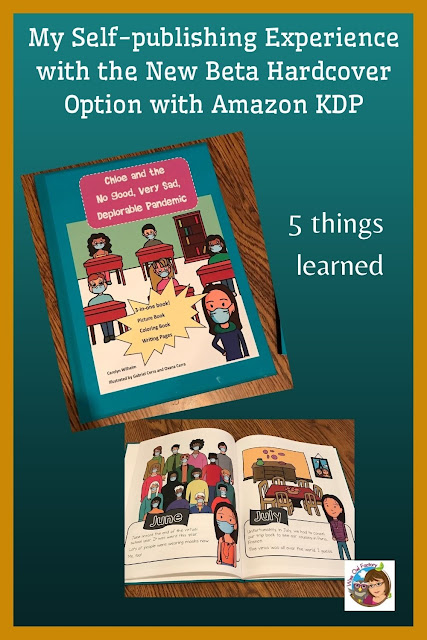
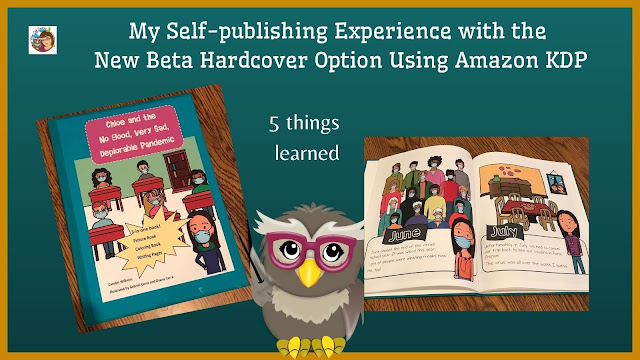
I recently tried the Amazon KDP hardcover beta option for one of my self-published children's books, Chloe and the No Good, Very Sad, Deplorable Pandemic, and one other book. Oxana Cerra illustrated the book with her son, Gabriel. 

First: Manuscripts of 75 pages are required

Five Things I Learned Trying Amazon's Beta Hardcover Option
First, I learned manuscripts of at least 75 pages for a children's picture book were required. That was the only way to upload the book not only for the hardcover but also for the paperback. Before, I could self-publish quite short children's books. I do sell shorter paperback children's books on Amazon. So, who knows? I just follow the rules. My story was done and not that long. What to do? The way I got around this without making the story longer as the artists were done was to make a "3-in-1" book with the story, the same story as a coloring book, and then a journal writing section. I waited to see if it would be accepted. It was. My other book was over 200 pages and not an issue. 

Second: Not all countries will publish hardcovers for self-published authors

Second, although the US does publish hardcover books through KDP, the UK does not do so. I was used to sending books through Amazon UK to some people. To send hardcover books of mine to those friends, I had to create a profile in a country that prints hardcover books and sends them to the UK. Although I studied French in high school, it was a little challenging to send it through French Amazon. I am now the proud unintentional owner of Amazon Prime in France, but I plan to send a few more books anyway. Germany and just a few countries also offer self-publishing hardcovers. Check because other countries are being added. 

Third: Templates are an issue

Third, I couldn't really find any templates like Amazon KDP has available for paperbacks and covers. The page says it is for hardcover and paperback, but when the templates are downloaded, they are the same as ever and the folder is labeled paperbacks. The way I created mine was to use Publisher. I had been using Word prior to this experience. Not everyone uses Publisher, I know. There were a few errors but when I used the preview, I didn't always see them. I just re-uploaded with no changes a few times and the book then had no errors. I don't know but try, try, try again worked for me. For the cover, my trick is to upload the paperback cover, and then the program tells me the file is wrong and what size to use. Then I resize it appropriately .*Note: I do have a commercial license for a template but what I use from that is the fonts. I like the manual control in Word. 

Fourth: Hardcover self-publishing is probably for the author and a few friends

Fourth, hardcover self-publishing through Amazon KDP is probably a "vanity" project, and just for the sake of having such a book. It is also good for gifts. It made me feel happy to have hardcover books. I actually never sent any manuscripts to publishers at all, I just self-published. So my expectation of ever having a "real book" (hardcover) was zero. I was delighted when Amazon offered a beta hardcover option. Libraries prefer hardcover, so this might be a choice for such a situation. 

Fifth: Hardcover KDP Self-publishing is very expensive

Five Things I Learned Trying Amazon's Beta Hardcover Option
Fifth,
oh, wow, spendy! One of my books, of course in color as it is for children, is $37 and I earn less than fifty cents. Hardcover publishing is not a to be a money-maker. The pandemic book is $20 and, yes, I earn less than a dollar. The KDP author's copy prices are lower, of course. And maybe, well for sure, black-and-white books would have a larger profit margin. I didn't even price black and white as yet. Children are used to color printing and lots of colors at that. Hardcover books will earn the least, paperbacks a little more depending on the price, and ebooks do earn the most in my opinion. 
Thank you for reading, 


MORE ABOUT THE BLOGGER Howard-Johnson is the multi award-winning author of fiction, creative nonfiction, and poetry. She is also a marketing consultant, editor, and author of the multi award-winning HowToDoItFrugally Series of books for writers including the multi award-winning The Frugal Book Promoter (http://bit.ly/FrugalBookPromoIII), now offered in its third edition by Modern History Press. Carolyn's latest is in the #HowToDoItFrugally Series of books for writers is How to Get Great Book Reviews Frugally and Ethically. She has two booklets in the #HowToDoItFrugally Series, both in their second editions from Modern History Press. Great Little Last Minute Editing Tips for Writers (http://bit.ly/LastMinuteEditsII) and The Great First Impression Book Proposal (http://bit.ly/BookProposalsII) are career boosters in mini doses and both make ideal thank you gifts for authors. The one on writing book proposals is also available as an Audio Book. The Frugal Editor (http://bit.ly/FrugalEditor), now in its second edition, is the winningest book in the series. Carolyn also has three frugal books for retailers including one she encourages authors to read because it helps them convince retailers to host their workshops, presentations, and signings. It is A Retailer’s Guide to Frugal In-Store Promotions: How To Increase Profits and Spit in the Eyes of Economic Downturns with Thrifty Events and Sales Techniques (http://bit.ly/RetailersGuide). In addition to this blog, Carolyn helps writers extend the exposure of their favorite reviews at TheNewBookReview.blogspot.com. She also blogs all things editing--grammar, formatting and more--at The Frugal, Smart, and Tuned-In Editor (http://TheFrugalEditor.blogspot.com). Learn more and follow for news on her new releases direct from Amazon at http://bit.ly/CarolynsAmznProfile.

Five Things I Learned Trying Amazon's Beta Hardcover Option


Sunday, August 01, 2021

Jacquelyn Lynn, Author and Mentor, Shares Book Publishing Essentials

There is a wonderful array of how-to books for authors who want to self-publish out there and authors who prefer to try the traditional route often benefit from those same books. Those who follow this blog probably know I believe that the more any author reads up on the publishing industry benefits from reading lots of them.  "One is never enough." In that spirit, many of my clients come to me simply wanting to know more about the publishing of a book. You know, the real essentials. Ta da! May I introduce my guest blogger today, Jacquelyn Lynn, who provides readers with exactly that with her The Simple Facts About Self-Publishing! This post includes excerpts from that book as well as more of her flat-out solid publishing wisdom. ~ CHJ


Ready to Publish Your Book?


Contributed by Jacquelyn Lynn


If you’re ready to publish a book, your options have never been greater—but how do you know where to start?


This excerpt from The Simple Facts About Self-Publishing: What indie publishers need to know to produce a great book by Jacquelyn Lynn will help.


Types of publishing

As you consider your self-publishing options, it’s important to understand the three basic types of publishers.


1. Traditional. Traditional publishers include the big New York operations and smaller presses around the country. They buy the rights to publish your book and pay you a percentage of the sales (royalties). Traditional publishers make their money on book sales. You don’t pay a traditional publisher to publish your book. Depending on the size of the publisher and the sales/revenue potential of your book, you may receive an advance against future royalties. Traditional publishers do all of the production work for you—editing, cover design, interior design, and so on—as well as handling the distribution, all at no cost to you. 


2. Self-publishing, also known as independent or indie publishing. This is when you publish your book yourself by handling all of the work or hiring subcontractors, such as editors or cover designers, to help you. Or you may hire a project manager to coordinate everything. The cost to self-publish ranges from minimal (if you do all the work yourself) to hundreds and even thousands of dollars, depending on how much you outsource. 


3. Hybrid or pay-to-publish. These are publishers that offer many of the same services that traditional publishers do but charge their authors. The term hybrid comes from combining traditional publishing services with the author-pay model, which used to be known as vanity publishing. While they might earn some money from book sales, the revenue of most hybrid publishers comes from what authors pay for services. Hybrid publishers may also be called self-publishing service companies (SPSC). The terms under which hybrid publishers operate vary tremendously by company, so if you’re considering this route, shop around and do your homework. For an author, this is the most expensive type of publishing.


Something most people don’t realize is that traditional publishers did a form of pay-to-publish long before today’s more transparent model became established. Instead of writing a check to the publisher, authors would guarantee to buy copies (often as many as 10,000-50,000) of their book as part of their publishing agreement. Frequently those publishing contracts would include an advance, but when the authors bought their copies, the publisher made back the advance and more. Whatever the publisher sold over what the author had agreed to buy was a bonus for them. This was a common arrangement with people who were speakers and could count on substantial back of the room sales at events or people who used their books as a marketing tool. Several of my ghostwriting clients over the years negotiated these types of book deals. I don’t know for sure, but I imagine it’s still happening.


Five publishing industry truths

Before we get into the nuts and bolts of publishing a book, let’s take a look at the publishing industry in general. Here are some truths you need to know:


1. There is no magic formula for success. This industry is run by humans, they’re all different, and they all make subjective decisions based on their own life experiences. Sometimes they’re right, sometimes they’re wrong. Most of publishing is a matter of guesswork—and luck plays a big role. 


2. Money and profits rule. Publishing is a business. Traditional publishers have to make a profit to stay in business, and most of their profits come from book sales. They have to be confident a book will sell before they accept it for publication. Hybrid or pay-to-publish operations make most of their revenue from authors. No matter what they say about your book’s potential, if you’re paying to get your book published, these publishers don’t take any chances—they get paid upfront from the authors. Money and profits are important in indie publishing, too. Your book may be a literary masterpiece but you can’t produce it without considering the financial side of the project.


3. The competition is tremendous. No one knows for sure how many books are published each year, but it’s a lot. Many industry observers think it’s more than one million. Book marketing expert Penny C. Sansevieri says it’s more than 4,500 per day. And your competition is not just all those other books—it’s movies, television, sports, games, and anything else a potential reader might spend time doing instead of reading your book.


4. Marketing a book takes a lot of work. Even great books by established authors need to be marketed. Whatever publishing route you choose, you’re going to have to market your book or it won’t sell. 


5. Not everyone will love your book. In fact, some people will hate it, and they’ll leave nasty reviews. Your feelings will be hurt. Learn to deal with it.


Advantages of self-publishing


Each of the publishing models—traditional, self-publishing (independent), and hybrid—has its advantages and drawbacks. Let’s take a look at the specific benefits of publishing your book yourself.


First, you have total control. Even though traditional publishers will consider your input, they have the final say over everything, including the title, the manuscript, the cover and interior design, scheduling, and so on. You’ll have input, but they make the final decision. When you self-publish, you have the final say. 


Second, you get to keep all the money your book earns. A traditional publisher will usually pay you an advance for your book—typically a few thousand dollars—and then you’ll earn royalties based on a percentage of the sale price of the book. Royalty rates are somewhat negotiable, but they’re generally in the 12 to 15 percent range. When you function as your own publisher, the difference between the sale price and your cost is yours. So let’s say your book sells for $20 and costs $4 a copy to produce. With a traditional publisher, you’ll earn about $3 on every sale; if you self-publish, you’ll receive $16. 


Third, you can get a self-published book on the market quickly. The time to market for traditional publishers is usually eighteen months to two years from contract signing. When you self-publish, your book is available as soon as it’s written and produced.


Perhaps the biggest advantage of self-publishing is that you can actually get your book published. It’s more difficult than ever for an unknown author to get a contract with a traditional publisher, especially for a book that has a narrow market. While self-publishing works for any type of book, it’s particularly effective for niche books and books with a concentrated regional appeal. Many authors self-publish with the hope of getting a traditional book deal down the road. That happens. It’s not unusual for traditional publishers to approach the indie author of a book that’s doing well. Many successful authors use a combination of self-publishing and traditional publishing throughout their careers.


The Simple Facts About Self-Publishing: What indie publishers need to know to produce a great book is an introduction to independent publishing that tells you what you need to know to produce a quality book that will delight your audience and meet your goals. You’ll learn the most common mistakes self-publishers make, how to avoid them, and how to produce a book that will look as good or better than the ones from top traditional publishers.


The Simple Facts About Self-Publishing gives you the knowledge you need to make the best decisions for your book, find the right resources and avoid getting ripped off. Available on Amazon or ask your favorite local bookstore to order it for you.


MORE OUR GUEST BLOGGER


Jacquelyn Lynn is the author or ghostwriter of more than 45 books. She has been traditionally published and is an independent publisher and publishing consultant. Connect with her at CreateTeachInspire.com.


Subscribe to Jacquelyn’s popular weekly email, Shareable Saturday: 10 Seconds of Inspiration to Wrap Up Your Week, at CreateTeachInspire.com/ss.


MORE ABOUT THE BLOGGER 


 Howard-Johnson is the multi award-winning author of fiction, creative nonfiction, and poetry. She is also a marketing consultant, editor, and author of the multi award-winning HowToDoItFrugally Series of books for writers including the multi award-winning The Frugal Book Promoter (http://bit.ly/FrugalBookPromoIII), now offered in its third edition by Modern History Press. Carolyn's latest is in the #HowToDoItFrugally Series of books for writers is How to Get Great Book Reviews Frugally and Ethically. She has two booklets in the #HowToDoItFrugally Series, both in their second editions from Modern History Press. Great Little Last Minute Editing Tips for Writers (http://bit.ly/LastMinuteEditsII) and The Great First Impression Book Proposal (http://bit.ly/BookProposalsII) are career boosters in mini doses and both make ideal thank you gifts for authors. The one on writing book proposals is also available as an Audio Book. The Frugal Editor (http://bit.ly/FrugalEditor), now in its second edition, is the winningest book in the series. Carolyn also has three frugal books for retailers including one she encourages authors to read because it helps them convince retailers to host their workshops, presentations, and signings. It is A Retailer’s Guide to Frugal In-Store Promotions: How To Increase Profits and Spit in the Eyes of Economic Downturns with Thrifty Events and Sales Techniques (http://bit.ly/RetailersGuide). In addition to this blog, Carolyn helps writers extend the exposure of their favorite reviews at TheNewBookReview.blogspot.com. She also blogs all things editing--grammar, formatting and more--at The Frugal, Smart, and Tuned-In Editor (http://TheFrugalEditor.blogspot.com). Learn more and follow for news on her new releases direct from Amazon at http://bit.ly/CarolynsAmznProfile.
Monday, August 26, 2019

The Benefits of Self-Publishing


The Benefits Of Self-Publishing Your Book
By Charles Bailey

Do you want to publish your very own book?

You have spent hours creating your plot and have all your character profiles.  

You have spent days looking at background information and months or years writing your novel.  

And you’ve spent a lifetime dreaming of the day you could pick up a bound copy of your own creative dream.

But with the ability to secure a book deal through traditional means becoming harder and harder, and hybrid-publishinghasn’t worked, what’s next for your dream?The answer is simple - self-publishing.  

This might cause you to wonder what the benefits of self-publishing your manuscript are.  

So we’ve gone and figured it all out for you. If you’re dreaming of becoming a published author but struggling to find a way forward via traditional publishing, here’s why self-publishing is right for you.

#1 - The Creative Control


The first and potentially the most important benefit of self-publishing is the control. Throughout this process, you will retain all of the creative control. 

There are 4 stages that generally make up the publishing process and they are writing, editing, design, and printing. 

When you self-publish, you can choose if you want to hire a professional to help you with these stages. Regardless of what you decide, you will be working for yourself and will not have to answer to anyone else. 

This is an important consideration for those with highly creative book goals. Cake-maker Pearl, from Pearl's Creations, reinforces this and says“as a cake maker I have a creative vision for a cookbook that has been in the back of my mind for a long time. However, I would not feel comfortable compromising on this vision just to say I was published. Instead, I’ve researched the self-publishing route as a way to write the cookbook of my dreams, without giving up control.”

#2 - The Financial Rewards


You have done all the hard work, so why should someone else be paid for it? 

With self-publishing, every cent that the book makes will go directly to you which is not the case with traditional publishing. You can then use this hard-earned money to get more advertising and make sure your book is out there for everyone to see. 

It’s a myth that marketing has to be expensive, with the marketing experts from Search It Localexplaining “marketing has become extremely accessible for entrepreneurs with many options available for those looking to publish. Consider starting a free website on Wix or similar, boost Facebook Ads for a minor fee, or even try your hand at guerilla marketing to drum up interest in your self-published book prior to launch. There are endless free or cheap options for marketing your new book.”

#3 - Pricing Control


With self-publishing, you get to decide how much your book will cost. Of course, if you are selling your book for a dollar, it will generally take forever to break even on the original costs. However, you will make more friends this way and the lower costs will increase the potential readership. 

On the other hand, if you charge $100 for a 100-page novella, there are few people who are going to purchase the book. You need to choose a sensible price for the book. This is possible because you have complete financial control and you could even give discounts. 

#4 - The Networking Opportunities


You will go through several stages in the production of your book. Along the way, you will be discussing the book with other people, researching your marketing channels and considering the press release for the book. Whatever happens in your publishing journey, they are all opportunities for you to network with people in the same situation or who can help you. 

#5 - The Self-Publishing Guarantee


When you work with a larger publishing house, they are going to be selective. They only choose to publish books they are sure will make them a lot of money. Generally, they will be looking for successful authors who are guaranteed to sell.  

Self-publishing your book will offer you a different type of guarantee. If you want to publish your work, you can. There will be no editors or publishers who say that you cannot or will not want to take on a new author.  

#6 - Publishing Later Works


There are very few retailers who are willing to stock a single book self-published author. If you are able to afford self-publishing a few books, you can use them to strengthen your reputation as an author. 

This will open avenues in the future with some of the traditional publishing houses being more willing to take on your next book. As the previous books you have are self-published, you can edit them and re-release them with the publishing house. 

At The End of the Day - This Is Your Book


Self-publishing allows you to do all the work for your book. You have gone from the first exciting idea for the plot to getthe first copy of your book delivered to you. According life coach Eiran Trethowan,this feeling of satisfaction can inspire you to go on and repeat the success with another book. She explains “in self publishing, youhave put in the effort and the book is completely your creation. You need to be proud of this and treasure your masterpiece while getting it out for everyone to read. Psychologically this can trigger a desire to recapture the same feeling, and actually help motivate you to achieve even more.”

There are a lot of successful self-published authors who continue to grow.  

Whether you want the fame and fortune of being an author or just want to share your work with the world, self-publishing is a provenoption.  

Don’t let your hard work end up in the recycling bin or gathering dust, take your destiny in your own hands, and become a self-published author.

AUTHOR BIO:

Charles Bailey is a freelance writer and university student based in Sydney. Majoring in Computer Science and Technology, Charles is also fond of fishing. When not at his desk creating content, he is outdoors soaking up the sunlight or going fishing with friends. 


MORE ABOUT THE BLOGGER

 Howard-Johnson is the multi award-wining author of fiction, creative nonfiction, and poetry. She is also a marketing consultant, editor, and author of the multi award-winning HowToDoItFrugally Series of books for writers including the award-winning second editions of The Frugal Book Promoter and The Frugal Editor. Her latest is in the series is How to Get Great Book Reviews Frugally and Ethically. Learn more on her Amazon profile page, http://bit.ly/CarolynsAmznProfile. Great Little Last Minute Editing Tips for Writers is one of her booklets--perfect for inexpensive gift giving--and, another booklet, The Great First Impression Book Proposal helps writers who want to be traditionally published. She has three FRUGAL books for retailers including one she encourages authors to read because it will help them convince retailers to host their workshops, presentations, and signings. It is A Retailer’s Guide to Frugal In-Store Promotions: How To Increase Profits and Spit in the Eyes of Economic Downturns with Thrifty Events and Sales Techniques (http://bit.ly/RetailersGuide). In addition to this blog, she helps writers extend the exposure of their favorite reviews at TheNewBookReview.blogspot.com. She also blogs at all things editing--grammar, formatting and more--at The Frugal, Smart, and Tuned-In Editor (http://TheFrugalEditor.blogspot.com)