About SharingwithWriters Blog


Named to "Writer's Digest 101 Best Websites," this #SharingwithWriters blog is a way to connect with my readers and fellow writers, a way to give the teaching genes that populate my DNA free rein. Please join the conversation using the very tiny "comment" link. For those interested in editing and grammar, go to http://thefrugaleditor.blogspot.com.
Showing posts with label jim cox. Show all posts

Saturday, September 05, 2020

Jim Cox of Midwest Book Review Shares Libraries Seldom-Used Resources

 Jim Cox of Midwest Book Review and I have been pen pals ever since we met at a writer's conference--was it some ten years ago? We kept in touch primarily because he puts out an amazing newsletter that is always pertinent to the writing life--sharing his wealth of accumulated publishing knowledge and reviews of books that are of interest in the publishing world. Of course, I couldn't resist telling him he is appreciated. That's a great way to make email pals these days.

Jim also gives me permission to reprint some of his letters and reviews. I tend to choose the ones about rarely covered topics in the blogosphere (and there are lots of them!). Today's is about some of the intricacies of  libraries' little-understood back alleys to provide resources for authors and a little about what Jim does to coordinate information he has that will be useful to them (and you!)  using the Publishers Bookshelf and Writers Bookshelf at #MidwestBookReview.  Keep reading:

Dear Publisher Folk, Friends & Family:

Back in the late 70s I lived in Monroe, Wisconsin, a small town in the south of the Badger state that had a modest but very nice public library. At that time I was also very highly engaged in reading everything by Robert E. Howard (the creator of the Conan books and the man who basically launched the fantasy subgenera known as Sword & Sorcery) that I could get my hands on. It seems that Howard had published a small book of his poetry called "Songs from an Iron Harp") back in the 1930s. The original print run was something like 300 copies and the book was exceedingly rare.

When I asked the Monroe librarian how I might be able to get my hands on a copy she introduced me to something called the Interlibrary Loan System. She put in a request for that rare book for me and about a month later the search turned up a copy in the collection of Brown University in Providence, Rhode Island. Those good folk wouldn't send me the book itself, but made a photocopy of the entire book, cover and all, and sent me that telling me that I could keep it. I still have that photo copy to this very day.

The Interlibrary Loan Service (sometimes called interloan, interlending, document delivery, document supply, or interlibrary service) is a service whereby a patron of one library can borrow books, DVDs, music, etc. and/or receive photocopies of documents that are owned by another library. The user makes a request with their home library; which, acting as an intermediary, identifies libraries with the desired item, places the request, receives the item, makes it available to the user, as well as arranges for its return. The lending library usually sets a due date and overdue fees of the material borrowed. Although books and journal articles are the most frequently requested items, some libraries will lend audio recordings, video recordings, maps, sheet music, and microforms of all kinds. In some cases, nominal fees accompany the interlibrary loan services. (Wikipedia)

Public and academic libraries have established voluntary associations, often on a regional basis, to provide an online union catalog of all the items held by all member libraries. Whenever a library adds a new title to its catalog, a copy of the record is also added to the union list. This allows librarians to quickly determine which of the other libraries hold an item. Software then facilitates the request and supply tasks. In the U.S., Online Computer Library Center (OCLC) is used by public and academic libraries. Formerly, another network RLIN (Research Libraries Information Network) was used primarily by academic libraries but merged with OCLC on October 1, 2007. (Wikipedia)

Online requests are usually submitted via OCLC's WorldCat or FirstSearch in the United States. Libraries without access to either can participate in interlibrary loan by submitting requests by postal mail, fax, email, or telephone call. These are referred to as manual requests. Manual requests can be submitted in the United States through the American Library Association. Individual libraries can agree to reciprocal arrangements between each other. (Wikipedia)

For those who might be curious, here is a link showing what an ALA Interlibrary Loan Service request form looks like:

I have archived on the Midwest Book Review website every review that I have ever done on 'how to' books for authors and publishers -- covering every aspect of the publishing process from writing an manuscript to marketing the published book. You will find them at:

Almost all of them (and there are hundreds of titles) can be obtained, for free, by aspiring writers, publishers, publicists, and non-specialist general readers with an interest in writing and publishing from their local community library through that same InterLibrary Loan Service that I was introduced to so long ago and have used for other titles from time to time ever since.

MORE ABOUT TODAY'S #SHARINGWITHWRITERS GUEST

Jim Cox is editor-in-chief of Midwest Book Review archives all of the previous issues of his "Jim Cox Report" the Midwest Book Review website at www.midwestbookreview.com/bookbiz/jimcox.htm. If you'd like to receive the "Jim Cox Report" directly (and for free), just send him an email asking to be signed up for it at http://www.midwestbookreview.com. And watch for reprints of some his favorite author-and-publishing related reviews here and on my #TheNewBookReview, https://TheNewBookReview.blogspot.com

MORE ABOUT THE BLOGGER 

 Howard-Johnson is the multi award-wining author of fiction, creative nonfiction, and poetry. She is also a marketing consultant, editor, and author of the multi award-winning HowToDoItFrugally Series of books for writers including the multi award-winning The Frugal Book Promoter (http://bit.ly/FrugalBookPromoIII), now offered by Modern History Press in its third edition. Carolyn's latest is in the #HowToDoItFrugally Series of books for writers is How to Get Great Book Reviews Frugally and Ethically. Learn more on her Amazon profile page (http://bit.ly/CarolynsAmznProfile). Great Little Last Minute Editing Tips for Writers (http://bit.ly/Last-MinuteEditsII) is one of her booklets--perfect for inexpensive gift giving--and, another booklet, The Great First Impression Book Proposal (http://bit.ly/BookProposalsII) helps writers who want to be traditionally published. The Frugal Editor (http://bit.ly/FrugalEditor), now in its second edition, is the winningest book in the series. Carolyn also has three frugal books for retailers including one she encourages authors to read because it will help them convince retailers to host their workshops, presentations, and signings. It is A Retailer’s Guide to Frugal In-Store Promotions: How To Increase Profits and Spit in the Eyes of Economic Downturns with Thrifty Events and Sales Techniques (http://bit.ly/RetailersGuide). In addition to this blog, Carolyn helps writers extend the exposure of their favorite reviews at TheNewBookReview.blogspot.com. She also blogs at all things editing--grammar, formatting and more--at The Frugal, Smart, and Tuned-In Editor (http://TheFrugalEditor.blogspot.com)

Wednesday, September 19, 2018

Celebrating 43 Years with a Treasured Quotation and a Self-Google Reminder!

I especially love Jim Cox's newsletter because "business" often turns into a lovely literary essay or a neat how-to article or just a reminder. This one (printed with his permission) is a bit of all three.  Thank you, Jim for being around and happy 43rd Anniversary for helping writers get reviews and sell more books!


Dear Publisher Folk, Friends and Family:

Every now and then I come across a genuinely inspiring and quotable quote. Like this one that is a part of the descriptive introduction for Karen Swallow Prior's "On Reading Well: Finding the Good Life through Great Books" as part of that book's Amazon.com entry:

"Reading great literature well has the power to cultivate virtue. Great literature increases knowledge of and desire for the good life by showing readers what virtue looks like and where vice leads. It is not just what one reads but how one reads that cultivates virtue. Reading good literature well requires one to practice numerous virtues, such as patience, diligence, and prudence. And learning to judge wisely a character in a book, in turn, forms the reader's own character."

I couldn't say it better and just wanted to share it with you.

This month (September 2018) marks the 43rd year of the Midwest Book Review, and me as it's editor-in-chief. At the ripe old age of 75 -- (76 come this November 6th) -- that means that I've been the editor-in-chief of the Midwest Book Review for more than half my life!

To celebrate this 43 year milestone (and just for fun) I went and looked us up on the internet with some Google searches. I really don't know what it means, if anything, but here is what I found:

1. Just typing the Midwest Book Review into the Google search box came up with so many entries that I got tired of clicking on all them after about 15 minutes or so. I was amazed at how many web sites that I had never heard of referenced the Midwest Book Review in terms of specific reviews from us or the services we provided, or the interviews I have given over the years.

2. I then typed in James A. Cox but ran into a lot of James A. Cox's out there. Then I tried James A. Cox + Midwest Book Review and got pages and pages of entries. And my ego being what it is, spent all too much time browsing through them -- blew another hour or so!

3. Then it occurred to me to enter Jim Cox + Midwest Book Review and while a lot of earlier entries turned up there were a fair number of new ones including one for a magazine interview I did for the Pennsylvania Literary Journal: Volume 9 (Spring 2017) which is apparently still for sale at:


and notes that "This issue includes an interview with Jim Cox, who has been editing the "Midwest Book Review" for over four decades, publishing thousands, if not hundreds of thousands of book reviews, with a focus on books from small presses that typically struggle with finding interested reviewers. Jim opens up about the realities of making a living from operating a review publication. His insight is essential to any author interested in self-promotion, and who is interested in how the review process looks from the other perspective. "

I also found still another long forgotten interview that I did with Marya Calvani for Blogcritic back in June 2008. You can find it at:


It's nice to be well thought of pretty much throughout the publishing industry down through all these many years.

But my own ego aside, the little exercise I went through this morning is something I would recommended all authors and publishers do in their own behalf at least once a year. For one thing, you could come across references to your work or reviews of your books that you might otherwise never know of.

Incidentally, I just plugged Midwest Book Review into the Amazon.com search box and it came up with 427 results. Not too shabby!"


MORE ABOUT JIM COX, TODAY'S GUEST AND INVETERATE REVIEWER

Those who would like to partake of Jim's wisdom and frequent review of books written specifically to help writers may subscribe to his newsletter at the MidwestBookReview.com website.  His daughter, Beth, also writes one with a focus on tech that will help writers.  You may reach him at at mwbookrevw@aol.com. Be sure to browse the site for great reviews and whole lists of resources useful for authors.


MORE ABOUT THE BLOGGER


Howard-Johnson is the author of fiction, creative nonfiction, and poetry. She is also a marketing consultant, editor, and author of the multi award-winning HowToDoItFrugally Series of books for writers including the award-winning second editions of The Frugal Book Promoter (where she talks more about choosing and the advantages of winning contests and how to use those honors)  and The Frugal Editor. Her latest is in the series is  How to Get Great Book Reviews Frugally and Ethically. Learn more on her Amazon profile page, http://bit.ly/CarolynsAmznProfileGreat Little Last Minute Editing Tips for Writers is one of her booklets--perfect for inexpensive gift giving--and, another booklet, The Great First Impression Book Proposal helps writers who want to be traditionally published. She has three FRUGAL books for retailers including one she encourages authors to read because it will help them convince retailers to host their workshops, presentations, and signings. It is A Retailer’s Guide to Frugal In-Store Promotions: How To Increase Profits and Spit in the Eyes of Economic Downturns with Thrifty Events and Sales Techniques. In addition to this blog, she helps writers extend the exposure of their favorite reviews at TheNewBookReview.blogspot.com. She also blogs at all things editing--grammar, formatting and more--at The Frugal, Smart, and Tuned-In Editor (http://TheFrugalEditor.blogspot.com )


Celebrating 43 Years with a Treasured Quotation and a Self-Google Reminder

Thursday, August 10, 2017

Must-Have Review Resource for Writers/Publishers

Do you know about Jim Cox's Midwest Book Review.  It's a lot more than a respected review site that considers all books based on their content and value,  not on the press they are printed on.  But it's a lot more than that. Reviews chosen for publishing may get included on any of a number of special editions aimed at librarians and specific regions.  This one by Diane Donovan, editor of The California Bookwatch, appeared on her "Writing/Publishing Shelf."  Reviewers and editors always give permission to expand the exposure of the reviews they write so that means when yours is chosen, you can submit it according to the guidelines in the left column to the sister of this blog, The New Book Review.   Be sure to subscribe while you're there. High participation benefits all the writers, publishers, and reviewers who contribute to it.

The Writing/Publishing Shelf

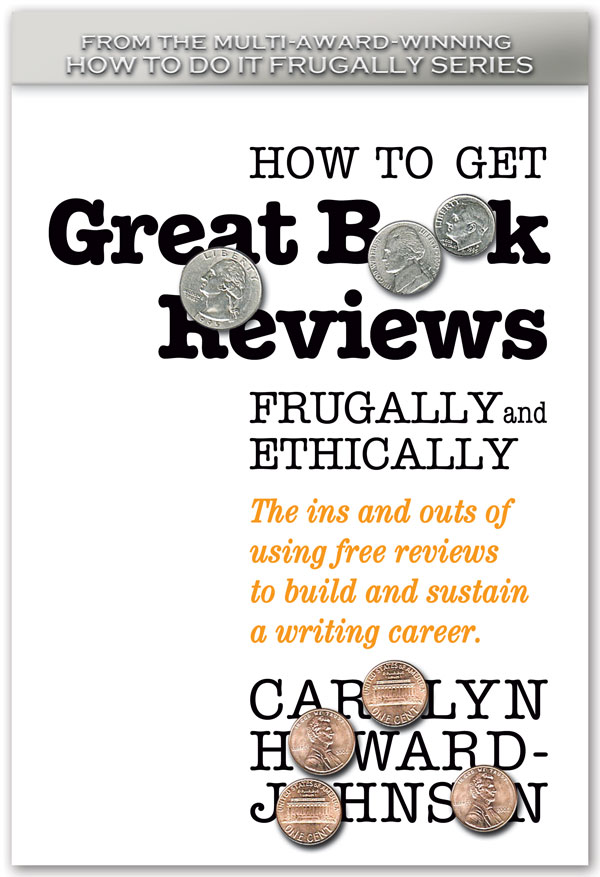
How to Get Great Book Reviews Frugally and Ethically
Subtitle: The ins and outs of using free reviews to build and sustain a writing career
Series: Third in the multi award-winning #HowToDoItFrugally Series of books for writers
Author: Carolyn Howard-Johnson
Website:  www.howtodoitfrugally.com
ISBN: 9781536948370, 

$17.95 PB, $9.95 Kindle
Available on Amazonhttp://bit.ly/GreatBkReviews

Reviewed by Diane Donovan, Editor of California Bookwatch, originally for her Writing/Publishing Shelf

How to Get Great Book Reviews Frugally and Ethically should be on the reading lists of anyone interested in gaining and, even more important, using book reviews. It informs both self- and traditionally-published authors of the ins and outs of getting and utilizing reviews; but most importantly, it discusses some of the tips and tricks for doing so - and reveals many approaches to avoid. From making the most of the best review from the most authoritative source to knowing what to do if the review process goes awry, this outlines the entire process of media promotion in the course of explaining the difference between a good and bad review, how they can be effectively utilized, and what to avoid. Very highly recommended!


Thursday, November 10, 2011

Book Promotion: A Book for Writers with "Enduring Value"

The Frugal Book Promoter, second edition
Carolyn Howard-Johnson
HowToDoItFrugally Publishing
Author's Web site: www.carolynhoward-johnson.com
ISBN: 9781463743291,
$17.95
 

Reviewed by Jim Cox, Editor of The Midwest Book Review
Originally for the Midwest Book Review and newsletter


Carolyn Howard-Johnson draws upon her many years of experience and expertise as a professional book publicist and marketing specialist to author "The Frugal Book Promoter". The 416-page compendium of commentary, advice, tips, tricks and 'real world' techniques on how to authors can obtain nearly free publicity on your own or by partnering with their publishers will prove to be an invaluable, practical, profitable, and thoroughly 'user friendly' instructional reference.
 
 It should be noted that the Midwest Book Review is cited four times. Of special note in this newly expanded and completely updated second edition are the sample letters query letters, media releases, blog entries, trade show invitations, phone pitch scripts, email auto-signatures, and tip sheets.
 
Simply stated, The Frugal Book Promoter is the single most valuable addition any aspiring author or novice small press publishers can add to their personal and professional book marketing reference shelves -- and has a great deal of enduring value for even the more experienced publisher marketing directors and publicists.
 
-----
Carolyn Howard-Johnson, author of This Is the Place; Harkening: A Collection of Stories Remembered; Tracings, a chapbook of poetry; and how to books for writers including, The Frugal Book Promoter: How To Do What Your Publisher Won't; The Frugal Editor: Put Your Best Book Forward to Avoid Humiliation and Ensure Success; and Great Little Last Minute Editing Tips for Writers . The Great First Impression Book Proposal is her newest booklet for writers. She has three FRUGAL books for retailers including A Retailer’s Guide to Frugal In-Store Promotions: How To Increase Profits and Spit in the Eyes of Economic Downturns with Thrifty Events and Sales Techniques. Some of her other blogs are TheNewBookReview.blogspot.com, a blog where authors can recycle their favorite reviews. She also blogs at all things editing, grammar, formatting and more at The Frugal, Smart and Tuned-In Editor . If your followers at Twitter would benefit from this blog post, please use the little Green widget to let them know about this blog:

Friday, June 11, 2010

Jim Cox Gives Writers the Inside Story on His Review Process

If you receive (and love!) the Midwest Review newsletter that gets delivered directly to your e-mail box as much as I do, you may disregard this post for you will have already read it. To all others, Jim Cox, trusted leader of Midwest Review, always has a valuable perspective on some aspect of publishing, in this case an aspect of our world that he probably knows more about than any other. Here is an excerpt from his letter. Read and take heed! (-:


Dear Publisher Folk, Friends & Family:

When I started my career as a book reviewer more than thirty years ago, I had the basics -- a desk, a bookshelf, a typewriter, a telephone, a rolodex with 60+ publisher's contact information, letterhead stationary, and a roll of stamps.

I worked part-time at what was pretty much the glorified hobby of a dedicated and life-long bookworm. I would get 2 or 3 packages of books a day and took the greatest delight in opening them up to see what was inside. It was pretty much Christmas Morning six days a week.

Now some 32 years later it's more like 30 to 50 packages a day coming into a mail room for one of my guys to open for me. So I thought I give a brief description of what happens to these books being submitted for review that now number about 2300 a month. Here's the process:

Basically when a book arrives in our mail room it is taken out of its packaging or box. The flattened out cardboard boxes and bags of packing material (foam chips and bubblewrap) are taken to a recycling center -- a trip which happens once a week.

The cover letters and publicity releases are placed physically inside the book. They are then piled in a carton with all the other titles to have arrived that day (and the numbers of books arriving on any given day will fill between two and four cartons).

These cartons of books are then taken to my office where their contents are piled on my desk. It's a very big 1950s era L-shaped steel secretarial desk that must weigh half a ton -- and th one enduring component that has been in my office from the beginning. Desktop computer systems and telephone systems have come and gone, but that big old desk is forever!

I then perform my daily literary triage and separate the books into three stacks: Rejection, Immediate Acceptance, and Provisional Acceptance.

The rejections are placed back into cartons to await their ultimate fate ranging from donation, to liquidation, to recycling centers. Those that are Immediately Accepted outright are set aside for their assigned reviewers. Those that are Provisionally Accepted are placed upon our bookshelves to await review assignment sometime within the next 14 to 16 weeks before they lose their eligibility for assignment and must be removed to make room for newly arrived review submissions.

So that's basically the daily process, Monday through Saturday.

A word about cover letters and publicity releases that absolutely must accompany a submitted book if it is to not be automatically rejected from consideration. The cover letter and the publicity release should both be printed out on business letterhead stationary. All too many self-published authors just jot down a note on plain paper, have no publicity release, or simply resort to a newspaper clipping in lieu of a formal PR.

As to what should be in those to essential documents and how they differ from each other, I've written it all down in simple, thoroughly 'user friendly' instructions that you will find on the Midwest Book Review website at:

Writing An Effective Cover Letter:
http://www.midwestbookreview.com/bookbiz/advice/cvr-ltr.htm

Writing An Effective Publicity Release:
http://www.midwestbookreview.com/bookbiz/advice/prelease.htm

Jim Cox
Midwest Book Review
Midwest Book Review
278 Orchard Drive, Oregon, WI, 53575

Note: It'd like to add that The Frugal Editor gives even more advice (and samples) on writing great query letters and my The Frugal Book Promoter gives the most complete information on putting together a media kit specifically designed for authors I've ever seen (if I do say so myself!).

-----
Carolyn Howard-Johnson, author of This Is the Place; Harkening: A Collection of Stories Remembered; Tracings, a chapbook of poetry; and how to books for writers including, The Frugal Book Promoter: How To Do What Your Publisher Won't; The Frugal Editor: Put Your Best Book Forward to Avoid Humiliation and Ensure Success; and Great Little Last Minute Editing Tips for Writers . She is also the author of the Amazon Short, "The Great First Impression Book Proposal". She has three FRUGAL books for retailers including A Retailer’s Guide to Frugal In-Store Promotions: How To Increase Profits and Spit in the Eyes of Economic Downturns with Thrifty Events and Sales Techniques. Some of her other blogs are TheNewBookReview.blogspot.com, a blog where authors can recycle their favorite reviews. She also blogs at all things editing, grammar, formatting and more at The Frugal, Smart and Tuned-In Editor . If your followers at Twitter would benefit from this blog post, please use the little Green widget to let them know about this blog:

Thursday, December 25, 2008

A Good Recession Is a Terrible Thing to Waste--For Writers, Too!

I am out of commission for a few days. My friends are filling in with guest blogs. I thought the lead on this article by my friend and reviewer Jim Cox was a lesson in itself. And, then, of course, there are all those good tips!

ByJim Cox
Reprinted from his newsletter


An economic crisis is a terrible thing to waste.

The publishing industry is very much a part of and affected by our nation's national and regional economies. Both the publishing industry and the country are in an economic crisis. But this is a crisis which is also an opportunity. Here's some of my thoughts on the subject of how writers, publishers, and book reviewers can weather the current economic recession--one that I think will continue through 2009 and not abate until at least the spring of 2010.

1. Revisit your business plan--and if you don't have one written down and at your fingertips then you absolutely need to stop whatever you are doing right now and create one!! Carefully look through your business plan for ways to consolidate, cut back, switch to more economical alternatives, and acquire the information necessary to be more frugal in your expenditures overall.

2. Keep a daily written record of all of your expenses--no matter how trivial. You'd be amazed at how much money can be spent on 'autopilot' because we are so used to shelling out for this, that, or the other. By identifying what we spend our money on we can then make informed decisions about what to continue, what to modify, and what to cut out altogether those items of expense that are "nice but not necessary".

3. Pay attention to your working environment. That goes for everything from leaving unnecessary lights on, to leaving computers on when not in use, to failing to ask for competitive bids for such things as stationary print jobs, phone service, equipment repairs, etc.

4. Never drive when you can walk or bike to where you have to go to do what you have to do. My own example is that I was in the habit of driving 14 blocks to the post office to mail off publisher notification letters every day--when after speaking to my post-office delivery person (who delivers book mail to my place Monday through Saturday) I found that I could simply rubber band the letters together and leave them on top of the emptied mail sacks in our mail room and she would be happy to pick them up for me. So now the only time I make a trip to the post office is when it is combined with other errands that would take me past it anyhow.

5. Explore the possibilities of winning grants to subsidize your operations. There's a learning curve to master here, but the good news is that there are several excellent 'how to' books on the subject of grant writing, as well as some very good Grant Giving Directories of organizations that give literary and publishing related grants. You can obtain these instruction books and reference books for free from your local public library through their InterLibrary Loan Service.

6. Put time and sweat equity into mastering the learning curve associated with marketing. That includes on-line marketing, hand-selling, non-bookstore venues, publicity/promotion tactics and strategies, etc. Again, you don't have to re-invent the wheel. There is an abundance of 'how to' instruction books specific to making money through writing and publishing. Your free public library will prove to be your new best friend in this era of economic downturns and retrenched consumer spending.

7. Avail yourself of the publisher resources you will find on the Midwest Book Review website including the archive of:
A. reviews of 'how to' books for aspiring writers seeking publication at: http://www.midwestbookreview.com/bookbiz/wr_shlf1.htm

B. reviews of 'how to' marketing books for novice and experienced publishers alike: http://www.midwestbookreview.com/bookbiz/pub_shlf.htm

C. low-cost and no-cost publishing resources http://www.midwestbookreview.com/bookbiz/pub_res.htm

The most effective way for authors and publishers to survive this economic recession to is increase revenues while decreasing expenditures.

The present economic recession has gripped out country for the last year, and it is one which I think will take at least another twelve months before ending. The next twelve months of economic hard times will shake out the weak, the unprepared, the unobservant, and the unmotivated, leaving standing only those who were wise enough to know that it is by educating themselves in the techniques of corporate survival will their own particular entrepreneurial publishing venture succeed, whether they are a self-published author or an independent publisher of other people's work.

Jim Cox
Midwest Book Review
278 Orchard Drive, Oregon, WI, 53575
http://www.midwestbookreview.com

-----
Carolyn Howard-Johnson, author of This Is the Place; Harkening: A Collection of Stories Remembered; Tracings, a chapbook of poetry; and two how to books, The Frugal Book Promoter: How To Do What Your Publisher Won't and The Frugal Editor: Put Your Best Book Forward to Avoid Humiliation and Ensure Success. She is also the author of the Amazon Short, "The Great First Impression Book Proposal". Some of her other blogs are TheNewBookReview.blogspot.com, a blog where authors can recycle their favorite reviews. She also blogs at all things editing, grammar, formatting and more at The Frugal, Smart and Tuned-In Editor blog.

Saturday, December 01, 2007

Postage Stamps, the Holidays and Your Book

Tidbit on Postage from the Midwest Review

I love Jim Cox's newsletter. He's the guru behind the Midwest Review; it is a generous effort he makes to help authors. In this edition he talked about the fun, personalized postage stamps that one can order to help promote one's books. These postage stamps may not have been intended for that, but they sure enough can be used that way.

It seems that the holidays are an especially good time to utilize this service though it is probably too late to do it for this season. In fact, think of the opportunity for anyone with a Christmas title, a cover that somehow broadcasts Christmas cheer (Kristin Johnson, your Christmas Cookie book would be ideal, wouldn't it?) But Mothers Day is coming, too. There are Valentines to be sent in February. Spring is coming, the season of love and pastels.

I haven't tried the postage stamps, though I've mentioned them in my newsletter before. I do keep thinking about it. The cost puts me off a bit. Instead I have used return labels from Vista Print featuring, yes, my return address, but also my book covers and my website address. If you want to know more about resources like Vista Print, please subscribe to my newsltter by sending an e-mail with "SUBSCRIBE" in the subject line to me at hojonews@aol.com.)

Here's what Jim says: "Three [resources for ordering] author/publisher customized stamps are www.utilized zazzle.com; www.photo.stamps.com; and www.yourstamps.com. If you do a Google search and type in Postage Stamps you will find them and many others you can choose from."

You may find buying your stamps directly from the postal service site, www.usps.com, more frugal. Let us all know in the comment section of this blog. (-:

Jim also says, "for you who are incorporated, or who are operating as an unincorporated sole proprietorship, remember that you can deduct for tax purposes not only the 41 cent cost of the individual stamps, but any and all costs of producing them as a line item in your business expenditures ledger."

To subscribe to Jim's newsletter, go to http://www.midwestbookreview.com. You won't be sorry you did. He runs a Q&A similar to the one you frequently find in my newsletter and sometimes on my blogs. It's only smart to take advantage of his knowledge by subscribing and asking him a question now and then.
------

Carolyn Howard-Johnson, author THIS IS THE PLACE; HARKENING: A COLLECTION OF STORIES REMEMBERED; TRACINGS, a chapbook of poetry; and two how to books, THE FRUGAL BOOK PROMOTER: HOW TO DO WHAT YOUR PUBLISHER WON'T; and THE FRUGAL EDITOR: PUT YOUR BEST BOOK FORWARD TO AVOID HUMILIATION AND ENSURE SUCCESS.
Her other blogs include TheNewBookReview.blogspot.com and AuthorsCoalition.blogspot.com, a blog that helps writers and publishers turn a ho-hum book fair booth into a sizzler.